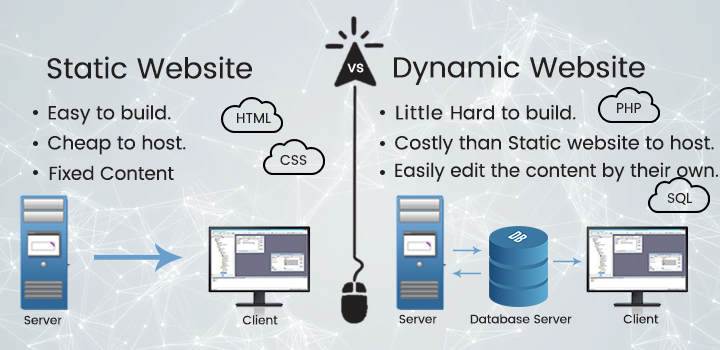
When planning a website for your business, one of the most important decisions you’ll make is whether to opt for a static or dynamic website. While both have their advantages and limitations, choosing the right type depends on your business requirements, budget, and future scalability needs. In this article, we’ll break down the key differences between static and dynamic websites to help you make an informed decision.
Understanding Static Websites
A static website is built using simple HTML and CSS files. Each page is a separate file, and the content remains fixed unless manually updated by a developer.
Advantages of Static Websites:
-
Faster Loading Speed: Since static websites don’t require server-side processing, they load quickly.
-
Cost-Effective: They are cheaper to develop and host because they require minimal resources.
-
High Security: No databases or server-side scripts reduce vulnerabilities to cyber threats.
-
Reliability: Static websites are less prone to crashes since they don’t depend on a database or complex backend code.
Limitations of Static Websites:
-
Difficult to Update: Content changes require manual updates to individual pages, which can be time-consuming.
-
Limited Functionality: Cannot support features like user authentication, real-time updates, or eCommerce transactions.
-
Not Scalable: Adding new features often requires rebuilding the website.
Understanding Dynamic Websites
A dynamic website generates content in real-time based on user interactions and backend logic. It typically involves programming languages like PHP, Python, or JavaScript, along with a database.
Advantages of Dynamic Websites:
-
Easy to Update: Content can be updated via a CMS (Content Management System) like WordPress or a custom admin panel.
-
Greater Functionality: Supports interactive features like user accounts, eCommerce, search functions, and real-time updates.
-
Better User Experience: Dynamic websites can personalize content based on user behavior and preferences.
-
Scalability: Easier to expand with additional features without major redevelopment.
Limitations of Dynamic Websites:
-
Higher Development Cost: Requires more time and technical expertise to develop.
-
Slower Load Time: Since dynamic websites process requests on the server side, they may have slower performance compared to static websites.
-
Security Risks: More vulnerable to cyber threats due to the presence of databases and server-side processing.
Which One Should You Choose?
The choice between a static and dynamic website depends on your business needs:
-
Choose a Static Website if:
-
You need a small, simple website with minimal updates.
-
Fast loading speed and security are your top priorities.
-
You have a limited budget and don’t require complex features.
-
-
Choose a Dynamic Website if:
-
You require interactive features like login systems, eCommerce, or user-generated content.
-
You plan to update content frequently and need a CMS.
-
Scalability and future expansion are important considerations.
-
Conclusion
Both static and dynamic websites have their advantages. If your business only requires a simple online presence, a static website may be the most cost-effective choice. However, if you need flexibility, frequent updates, or advanced functionality, a dynamic website is the better option.
At Cybros Infotech, we specialize in both static and dynamic website development tailored to your business needs. Contact us today to discuss which option is best for you!